
The world’s financial infrastructure is being rewired for the digital age. As digital assets move into the mainstream, the advent of agentic commerce is now set to accelerate and converge many of the innovations we’ve seen gaining commercial traction in recent years. In this article, Chris Baker explores how these trends are reshaping the future of commerce and financial services.
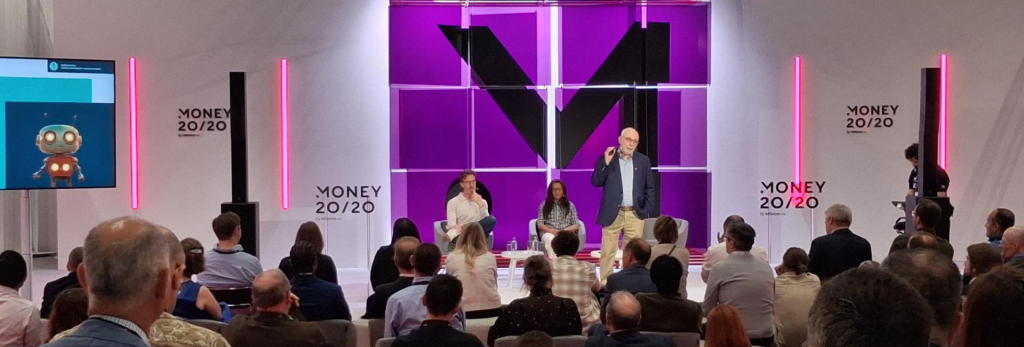
“We need a new money for a new economy” declared author David Birch at Money 20/20 Europe.
Birch was drawing parallels between stablecoins and the privately made “tradesman’s tokens” minted to fuel the Industrial Revolution in late 18th century England. His point is that when the right kind of finance doesn’t exist, the private sector will create it.
The new economy that he’s talking about is a digital one, in which artificial intelligence agents, or bots, will make payments on behalf of businesses and consumers.
A digital economy requires new infrastructure. Agentic commerce will need payments that can be initiated, authenticated, risk-checked and settled by machines, at machine speed. The consequence is that various threads of financial innovation – stablecoins, open banking, tokenised deposits, digital identity and compliance data – have now become part of the same conversation.
Fintechs are racing to become the infrastructure partner of choice for agentic banking, ecommerce and embedded finance – attracting both investment and talent.
Mastercard, Worldline and Dutch bank ING used Europe’s biggest fintech show to demonstrate “Europe’s first end-to-end agentic payment”. An AI agent acting on behalf of an ING customer sent a payment for a wedding anniversary gift to a Worldline merchant in the Netherlands.
The same week, AI-powered fashion platform Hey Savi launched what the company has described as “the UK’s first agentic commerce experience” with a “native checkout” powered by PayPal’s agentic commerce services and Debenhams Group as the first UK retail adopter.
While we’re still very early in this journey, and many are sensibly questioning whether this is something consumers are ready for, the direction of travel, and investment, is clear.
Businesses of all types, not just retailers and merchants, need to be thinking now about what they need to be doing to prepare for this change and how soon they need to invest in the technology and skills they need to engage with it.
The week after Money 20/20, the UK government made a series of announcements of funding for physical AI Infrastructure at London Tech Week: seeking to secure greater sovereignty over the semiconductors and the datacentres that will be required to support an AI-intensive economy. For most people, this is the type of hardware we think about when we consider infrastructure.
When it comes to financial infrastructure, however, what we’re really talking about are the payment rails upon which the world’s business and commerce take place, and this was the focus of much of the discussion, and news, in Amsterdam.
The big shift which has taken place in the last year has been the convergence of traditional finance (TradFi) – the banking and payment networks that we’re all familiar with – and decentralised finance (DeFi) – the digital, tokenised assets which most people think of as cryptocurrency.
If Money 20/20 Europe has previously felt like a showdown between traditional banks and neo banks, this year’s primary tension was between TradFi and DeFi.
While Francesca Carlesi, UK CEO of Revolut was on the Mastercard stage explaining to Bloomberg’s Aisha Gani how it aims to make the most of its new banking licence, at the other end of Hall 1 a new Intersection Stage hosted a series of Big Debates pitting the evangelists of a decentralised future against those who believe that the fundamentals of money and trade haven’t changed.
This is a false dichotomy. What we’re really seeing now is convergence between the two – with bigger DeFi firms becoming regulated financial services, while banks begin to embrace tokenisation – but the Big Debates provided a fun format to explore what’s happening and where it will all go.
Whereas crypto assets used to sit outside of traditional networks, in the last year institutional interest in stablecoins – crypto currencies pegged to fiat currencies – has been boosted by regulations in the EU (MiCA) and US (The Genius Act) providing a framework for greater integration with traditional rails.
One company which has benefitted from this is Fireblocks, which provides the enterprise infrastructure and custody solutions that banks, payment providers, and financial institutions use to transact, secure, and move USDC. CEO Michael Shaulov told Tony Clark on his live London Fintech Podcast that the company currently processes 15% of global stablecoin volume.
To date, the landscape has been dominated by dollar-denominated private stablecoins, led by Tether’s USDT and Circle’s USDC, which currently account for about 80% of the market. As sovereignty has become a political priority, however, other regions have started exploring and designing central bank controlled digital currencies such as the digital euro, and potentially the digital pound.
So far, the clearest use cases for stablecoins have been in economies which don’t already have strong or reliable financial systems. People and businesses are using stablecoins to transact in digital dollars in places where fiat dollars are otherwise hard to access, while avoiding the risks of local currency volatility and settlement delays in traditional correspondent banking rails. Proponents also argue that digital assets can offer resilience when physical cash, banking access or local currency stability are under pressure, including in conflict-affected markets such as Ukraine.
Some regulators, such as the IMF, have warned that the same features can create AML or monetary-policy risks and be used to circumvent legitimate sanctions.
In the UK, the Bank of England is proceeding cautiously. It is developing a regime for systemic sterling stablecoins and exploring tokenised settlement in wholesale markets, while seeking to preserve financial stability and the singleness of money. Potential benefits include faster and cheaper settlement, especially for cross-border and wholesale transactions, as well as programmability through smart contracts. But UK authorities have stressed that these benefits depend on robust regulation, interoperability and safeguards around reserves, redemption and systemic risk.
The potential advantage of central bank issued digital currencies is that they could enable the speed and programmability of digital assets while retaining trust and monetary sovereignty of central bank money, without ceding currency sovereignty to the private sector. This pattern echoes Birch’s example from the 18th century, when central banks stepped back in to take control of coinage in the wake of private innovation.
Birch, however, believes agentic commerce will change the game. “The main users of stablecoins will be AI,” he said. “Though in the long run, digital assets won’t matter. In future: what money will AI exchange?” The rails stablecoins are laying down now are the rails that these other digital assets will grow on, he predicts.
The question is whether our existing financial infrastructure is ready for agentic commerce, which will require payments infrastructure to “move at the speed of the internet”?
The other technology which is, at last, likely to be unlocked by agentic commerce is open banking. As Equals CPO James Simcox predicted for the Payments Association last year, unlike humans, agents have no qualms about entering long IBAN numbers in order to make direct account-to-account payments. The benefits of this system are that it cuts out credit and debit card fees for merchants, while giving consumers control over who can collect money.
The UK took a big step towards A2A payments at Money 20/20 with the launch this month of the UK Payments Initiative Ltd (UKPI), the first new UK payment scheme since Faster Payments in 2008. An initiative backed by thirty banks and fintechs, welcomed by the Financial Conduct Authority, the scheme provides businesses with a unified rulebook and operational standards for managing automated, recurring transfers directly from bank accounts.
Commercial applications have already been deployed by TrueLayer, whose Bank on File platform replaces legacy billing infrastructure with biometric-authorized consumer consent, and GoCardless’s Recurring Pay by Bank payment solution. Go Cardless Chief Product Officer Shaun Puckrin told Fintech Times that because the UKPI system is built directly on APIs for real-time transfers, it could provide a structural foundation for agentic commerce.
If you think AI agents making payments to other AI agents using crypto assets sounds like a recipe for disaster, you’re not the only one with reservations. One of the biggest barriers for AI at the moment is trust – for consumers, businesses and for regulators.
Agents performing actions instead of people changes the game for verification to avoid fraud and anti-money laundering.
This is creating big opportunities for any businesses offering solutions. In the week around Money 20/20 autonomous banking startup Gradient Labs, founded by former Monzo engineers, raised a $26m Series A extension to scale regulated AI agents for lending, disputes and Know Your Customer. Gradient are selling these services to banks, fintechs and other regulated financial services firms.
Others have pointed out that even existing systems need fixing first. Kyckr, a B2B data provider that helps financial institutions, fintechs, and legal firms automate Know Your Business (KYB) and Anti-Money Laundering (AML) checks, recently conducted research to identify the data infrastructure gaps. Its analysis of 22 Financial Conduct Authority enforcement cases, resulting in over £430 million in anti-money laundering fines, found that weak ownership, identity and customer data remain recurring causes of AML control failures. The lesson is: better data transparency – a challenge that needs to be solved before agentic commerce takes off.
In future, will all payments be made by AI agents? Will all money run through programmable digital rails? Based on the patchwork adoption of every other technology in human history, it’s highly unlikely. Traditional banking is not dead. But agentic commerce is coming and the frameworks on which the world’s money moves are being reengineered in real time, whether we can see them or not.
The question is how to make money move in a digital age. The answer is, as always, by adopting new technologies and finding the partners who can provide the infrastructure required.
Payments are being redesigned for a world in which software agents can search, negotiate, authenticate and transact. Whether those transactions settle over cards, account-to-account rails, stablecoins, tokenised deposits or CBDCs, the question is the same: who can provide the trusted infrastructure for machine-speed commerce?
For the proponents of decentralised finance, this is a chance to move from the margins into mainstream financial infrastructure. Neobanks such as Revolut believe that their lack of legacy architecture makes them best placed to adapt, while infrastructure-focussed fintechs sell their technology to banks and start-ups alike.
As these competing systems race forward, from innovative start-up concepts to trusted global use cases, it’s certainly an exciting time to be working in fintech.
******
At Speed, we help fintech and payments businesses turn complex infrastructure stories into media narratives that investors, partners and customers understand. At Money20/20 Europe, we supported the relaunch of Equals, the embedded and global payments platform, securing 28 pieces of coverage and two days of interviews with target media at the show.
This was followed by the launch of a report with Visa Consulting on embedded finance adoption in Western Europe, generating further 15 pieces of industry coverage and thought leadership.
To discuss how strategic PR can help your fintech business build authority in a changing payments market, contact Chris Baker, Senior PR Consultant, at chris.baker@speedcomms.com